
Indian equity benchmark indices experienced a significant drop in early trade, with the BSE Sensex falling over 525 points and the NSE Nifty down more than 164 points, primarily due to rising crude oil prices and ongoing uncertainty surrounding the US-Iran conflict.

Indian benchmark equity indices, Sensex and Nifty, saw gains in early trade, driven by strong performance in banking shares and positive sentiment from Asian markets, alongside optimism surrounding the ongoing US-China Summit.

Indian equity benchmark indices, Sensex and Nifty, ended marginally lower in a volatile trading session, surrendering early gains due to profit-taking in blue-chip stocks and persistent macroeconomic concerns, despite positive global cues.

Trading turnover on NSE IX has been witnessing an uptrend and this momentum is likely to continue thanks to the growing global interest in the overall India growth trajectory, MD & CEO of NSE International Clearing Neeraj Kulshrestha has said. Speaking at the Singapore Fintech Festival (SFF) on Monday Kulshrestha said foreign investors are likely to further increase their participation in GIFT City NIFTY.

Foreign investors were net sellers of domestic debt in October for the first time since the official inclusion of Indian government bonds in the JP Morgan bond indices, with net outflow worth Rs 4,697 crore. This marked the second instance in the current calendar year where foreign portfolio investors (FPIs) were net sellers in a month.

Indian equity markets, including the Sensex and Nifty, experienced a significant downturn for the second consecutive day, driven by escalating geopolitical tensions in West Asia and persistent foreign fund outflows.

Indian benchmark indices Sensex and Nifty experienced volatile trade, declining in early deals before fluctuating, as investors reacted to unabated foreign fund outflows and rising geopolitical uncertainties, particularly in West Asia.

The Indian rupee rebounded 50 paise from its all-time closing low to settle at 96.36 against the US dollar, driven by retreating crude oil prices, signs of easing geopolitical friction, and likely central bank intervention.

Sensex gains over 400 points while Nifty trades above 23,800 amid strong IT sector buying.
Indian benchmark equity indices, Sensex and Nifty, rebounded on Wednesday, recovering intraday losses, primarily driven by strong fag-end buying and a significant rally in blue-chip Reliance Industries.
Indian equity benchmark indices, Sensex and Nifty, tumbled nearly 2 per cent for the fourth consecutive session, driven by elevated crude oil prices, escalating US-Iran tensions, unabated foreign fund outflows, and a depreciating rupee.
Indian equity benchmark indices, Sensex and Nifty, tumbled nearly 2 per cent for the fourth consecutive session, driven by elevated crude oil prices, escalating US-Iran tensions, unabated foreign fund outflows, and a depreciating rupee.

Foreign Portfolio Investors (FPIs) have withdrawn Rs 19,837 crore from Indian equities in the first two trading sessions of April, extending a significant selling trend from March, driven by geopolitical uncertainty, rising crude oil prices, and a depreciating rupee.

Analysts predict that the ongoing US-Iran conflict, fluctuations in crude oil prices, and foreign institutional investor (FII) flows will be the primary factors influencing Dalal Street this week, with inflation concerns adding to investor anxiety.

Indian benchmark indices, Sensex and Nifty, closed marginally higher after a volatile trading session, driven by value buying in IT and select blue-chip counters, despite global crude price hikes and a weak rupee.

Indian benchmark indices Sensex and Nifty experienced a significant slump in early trade, mirroring weak global trends, as escalating tensions in West Asia, particularly a drone attack on the UAE's Barakah nuclear facility, pushed crude oil prices higher. Track Sensex, Nifty50 movement and key market drivers for May 18, 2026.
Indian equity markets experienced a significant downturn as geopolitical tensions in West Asia, rising oil prices, and foreign fund outflows dampened investor confidence. The Sensex and Nifty both fell sharply in early trade, reflecting broader global market weakness.
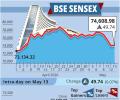
Indian benchmark equity indices, Sensex and Nifty, closed marginally higher, breaking a four-day losing streak, despite elevated crude oil prices and ongoing geopolitical uncertainties. The market saw a temporary pause in panic selling, though cautious sentiment persists.

Indian equity benchmark indices Sensex and Nifty rebounded in early trade, driven by buying in blue-chip stocks and a positive trend in Asian markets, with domestic institutional investors providing crucial support.

Amidst a sharp run-up in gold and silver prices, investors are advised to rebalance their portfolios by booking partial profits in precious metals and reallocating to domestic equities and debt, according to financial experts.

'You set up your SIPs and you do not touch them. Not during COVID, not during a war scare, not when your neighbour tells you the market is finished. You let the noise pass over you.' 'The beauty of this approach is that it does not require courage or conviction in the moment. It just requires inertia -- keep the SIP running and do not look at your portfolio too often.'

The rupee weakened to a record low against the US dollar due to Gulf tensions, rising oil prices, and foreign capital outflows.

India's mergers and acquisitions (M&A) market is projected to maintain an annual run-rate of approximately $200 billion, evenly split between domestic, inbound, and outbound transactions, despite global geopolitical turbulence, according to Rajesh Singhi, global co-head, M&A Advisory, Standard Chartered Bank.
Indian equities on Dalal Street saw volatility as global market trends and fresh tariff concerns linked to Donald Trump impacted investor sentiment. Track Sensex, Nifty50 movement and key market drivers for March 30, 2026.
Indian stock markets concluded Tuesday's trading session lower, reversing intraday gains due to late-session selling in blue-chip stocks like HDFC Bank and Reliance Industries. The decline was primarily driven by the Indian rupee hitting a new record low against the US dollar and elevated global crude oil prices, compounded by geopolitical uncertainties.

The Indian rupee depreciated 20 paise to close at a fresh all-time low of 94.88 against the US dollar, driven by surging Brent crude oil prices, hovering around USD 115 per barrel, and persistent foreign capital outflows.

Indian benchmark indices Sensex and Nifty closed higher, with the Sensex climbing 355.90 points, driven by positive state election results and better-than-expected Q4 earnings, despite ongoing geopolitical concerns.

The U.S. Department of Justice has permanently dropped all criminal charges against Indian tycoon Gautam Adani and his nephew Sagar, bringing a high-profile securities and wire fraud case in New York to a close after prosecutors concluded they could not sustain the allegations.
Indian equities on Dalal Street saw volatility as global market trends and weak rupee impacted investor sentiment. Track Sensex, Nifty50 movement and key market drivers for May 5, 2026.

Indian benchmark equity indices, Sensex and Nifty, closed lower due to investor caution over rising bond yields, a weaker rupee, and fresh fuel price hikes, which have revived inflation concerns.
The rupee recovered to 95.18 against the US dollar after hitting an all-time intra-day low of 95.44. The recovery was supported by possible RBI intervention amid renewed Gulf tensions and rising crude oil prices.

The Indian government has issued an updated Standard Operating Procedure (SOP) for processing Foreign Direct Investment (FDI) applications, aiming to clear all proposals within 12 weeks, a two-week extension from the previous 10-week target, to ensure a fully paperless and transparent process.

The central bank is yet to consider actions such as a rate hike or mobilising dollar inflows from non-resident Indians to boost forex reserves as it cannot afford to continue with them for long when the rupee's internationalisation tops its agenda, explains Tamal Bandyopadhyay.

'Markets never fully lose hope. But an important shift could come if the Strait remains closed -- moving from high prices to no prices.'

The US Department of Justice has permanently dropped all criminal charges against Indian tycoon Gautam Adani and his nephew Sagar, concluding a high-profile securities and wire fraud case in New York after prosecutors determined they could not sustain the allegations.
Indian benchmark indices Sensex and Nifty experienced a decline due to renewed geopolitical concerns in the Strait of Hormuz, a strained US-Iran ceasefire, and the rupee hitting a record low against the US dollar.

The Enforcement Directorate (ED) has attached properties worth Rs 1.06 crore in connection with the 'Global Media App' fraud, an online earning platform that allegedly generated over Rs 45 crore through illicit means.

Indian benchmark indices Sensex and Nifty experienced a sharp decline in early trading due to escalating tensions in the Middle East, driving crude oil prices higher. Global market bearishness and foreign fund outflows further contributed to investor unease.
Indian benchmark indices Sensex and Nifty experienced a significant slump in early trade, driven by a sharp surge in crude oil prices above USD 120 per barrel, weak global market trends, and continued foreign fund outflows.

Is the current rally telegraphing a durable peace plan in West Asia, boosted by United States (US) President Donald Trump's incoherent and contradictory posts on social media?
 © 2026 Rediff.com - Advertise with us - Disclaimer - Privacy Policy - Sitemap - Feedback - About us - Terms of use - Grievances